What Does Blood Flow Restriction Bands Do?
Occlusion training, or who call "blood flow restriction training" (BFR), involves restricting blood flow in the veins of the working muscles to cause an increase in strength.
Product description
Occlusion training, or who call
"blood flow restriction training" (BFR), involves restricting blood
flow in the veins of the working muscles to cause an increase in strength. If
you want to make the most of your exercise program, especially to exercise your
arms, legs, and buttocks muscles, please read this article carefully to know how to use blood flow restriction bands?
Part 1: Do Blood Flow Restriction Bands Work
The first thing you need to know about BFR is that its goal is not to completely cut off the blood supply to the muscles.
This is just to slow down the return of blood from the muscles to the heart.
This causes the blood to stay in the muscles longer than usual, this affects muscle physiology in many ways.
Your heart pumps blood into your muscles through arteries, which are large muscular wall tubes throughout your body. The blood returns to the heart through veins, which are a set of different tubes that run through your body.
When you do strength training, especially in the higher reps, the amount of blood flowing from the heart to the muscles exceeds the amount of blood flowing from the muscles to the heart.
When you rest between sets, the veins
are restricted, which prevents blood from leaving the working muscles too
quickly, and blood slowly drains back to the heart from the congested muscles.
Part 2: Blood Flow Restriction Training: What Is It? How Does It Work?
What is Blood Flow Restriction Training?
Blood flow restriction training (BFR)
is a form of strength training. Depending on your training content, use a
higher number of times and a lighter load when wearing compression bands, tourniquets,
or blood pressure cuffs on your upper arms or legs.

Benefits of Blood Flow Restriction Training
Because blood flow restriction
training slows down the excretion of sports metabolites from the muscles, and
allows them to stay longer to produce greater anabolic effects on muscle cells.
Resistance training also causes cells
to swell and fill with fluid and nutrients. This is called "cell
swelling" and it is also a signal of muscle growth.
For Occlusion Training
Occlusion
training can increase the strength of muscle exercise by increasing the time of muscle
cell swelling. Blood flow restriction training is very helpful in this regard,
because it does not increase the level of muscle activation more than normal
training, it does allow you to obtain a higher total level of muscle activation
during exercise, and muscle damage is less.

Part 3: How to Use Blood Flow Restriction Training for Therapy?
There are some blood flow restriction
training pros and cons. In a clinical setting, it is impossible to use moderate
to high load resistance training.
By using occlusion training, you can significantly
reduce your load while still achieving acceptable levels of muscle strength and
growth.
The possible risks come from several
variables: improper bands width, excessive bands pressure.
First of all, we will solve the
problem of the width of the blood flow restriction bands, which many people in
the fitness have incorrectly understanding. BFR works by slow down blood flow.
According to multiple study, a wider cuff can reduce the pressure required to
restrict blood flow. This means that the small size blood flow restriction
bands sold by many manufacturers increase the risk of muscle tissue injury. You
must use a wider band to reduce this condition.
The place where BFR is use is very
important. There are only two parts where the BFR band should be used. That is
the upper arm and upper thigh. This will minimize the risk of nerve damage. It
is well known that incorrect use of blood flow restriction bands can cause
nerve damage, including nerve palsy such as drooping feet.
Part 4: How to Use Blood Flow Restriction Band for Strength training
The strap should be placed as high as
possible on your limb. This means that when you train your upper body (arms,
back, chest), you should put them in your armpits.
Blood Flow Restriction Bands for Glutes
Blood flow restriction band for the
legs (quadriceps, hamstrings, calves, buttocks, etc.), extend them into the
groin. The blood flow restriction bands should be just below the fold between
the hips and the back hamstrings.
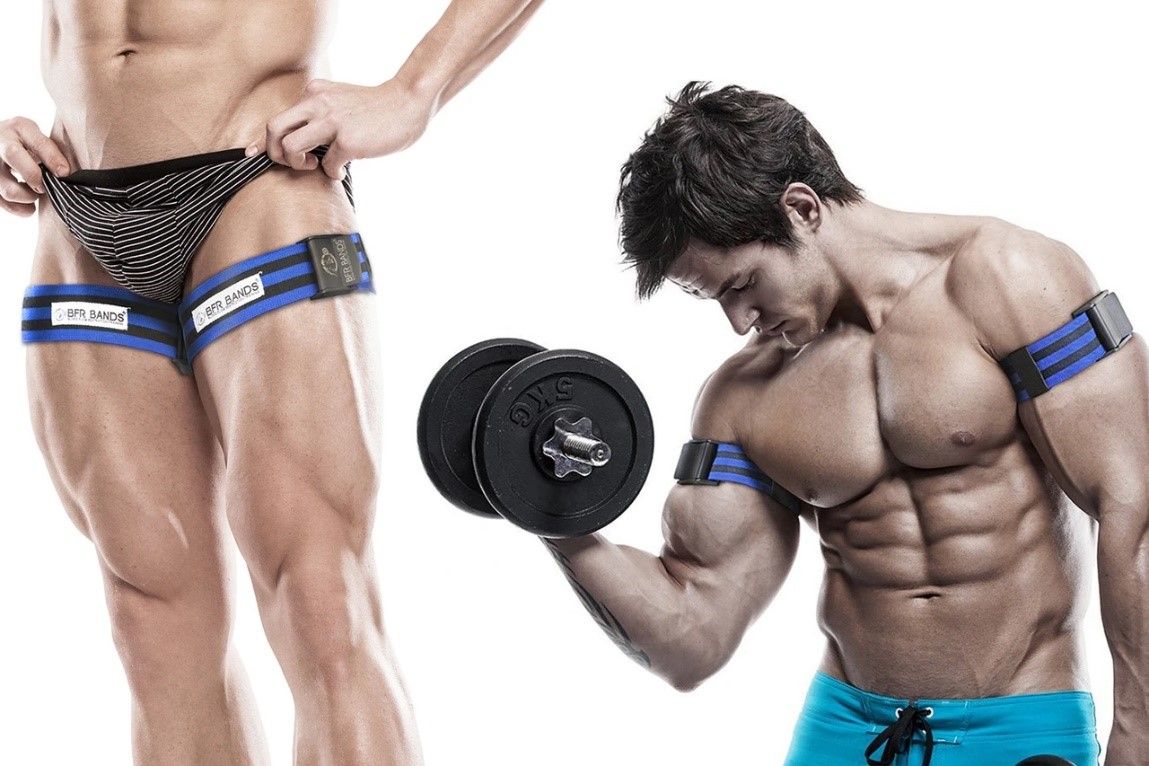
Occlusion training has a positive
effect on the muscles below and above the cuff, so putting them on the upper
arm does affect chest or back strength and muscle growth, as well as biceps,
triceps, etc.
Try to wear as little clothes as
possible. For the upper body, a sleeveless shirt is the perfect choice.
Most importantly, you don't want thick
clothes under your wraps or straps because it will make the pressure uneven,
and you will end up with a large piece of clothing that will swell and press
too tightly under the cuffs.
Tips 1: Warm up Before Blood Flow Restriction Training
The blood flow restriction training is
performed at the intensity normally used in the warm-up set. Therefore, it is
recommended that you first perform a light aerobic warm-up exercise (such as
walking or light cycling), and then perform 15 unfolding repetitions using the
weight you will use for the first set of blood flow restriction training.
Tips 2: Adjust Your Reps and Rest Time
When you want to increase the
intensity and amount of fitness. Blood flow restriction training uses the
number and frequency of higher metabolic requirements, and the rest time is
much shorter (usually 30-45 seconds).
Tips 3: Don't overuse
BFR training will cause muscle fatigue
after training. Therefore, it is important to adjust recovery accordingly, but
compared to weightlifting, there is less muscle damage during low-load BFR
training.
If you have just started restricting
blood flow training or are not used to this kind of high repetition training,
you may need a little longer to recover from this kind of metabolically
demanding training. First, only do BFR training once or twice a week until your
muscles recover in about 24 hours.
How to Choose the Right Fitness Band
To do blood flow restriction training,
you need a fitness band—to restrict the blood flow to the limb you are
training. Whatever you choose, you need to make sure that you are only
restricting the return blood flow and not completely stopping it.
Summary:
There are many suggestions on what do BFR bands do
for glutes. The BFR booty belt helps women's leg development and gluteal muscle
growth by temporarily restricting blood flow into the muscles, accumulating
lactic acid and HGH (human growth hormone). BFR training requires as accurate
pressure as possible, if you want to get the most effect in the gym and
accelerate the realization of your fitness goals, this is an ideal product.
AIXPI blood flow restriction training bands specially designed for women which be able to increase strength quickly and exercise faster.